Cloudion
Choosing an industrial ai server manufacturer is a technical decision, not merely a purchasing exercise. The selected platform may control robotic arms, inspect welds, or analyze vibration data continuously. A failure beside a production line can stop more than software. It can stop people, materials, and schedules.
Jensen Huang, founder and CEO of NVIDIA, has described AI as “the most powerful technology force of our time.” His statement highlights an important point: industrial AI requires dependable computing foundations. Buyers should examine GPU compatibility, ECC memory, thermal design, power efficiency, and expansion capacity. These details matter inside a dusty factory cabinet. They matter even more during a summer shift.
A credible industrial ai server manufacturer should provide documented benchmarks, traceable component sourcing, and long-term firmware support. Ask whether the system handles sustained workloads, not only short laboratory tests. Review warranty response times and on-site service options. Check the manufacturer’s experience with machine vision, predictive maintenance, and industrial networking. References from comparable plants are stronger than polished brochures.
Cost still matters. It is not everything. A cheaper server may create higher downtime, replacement, and integration costs. However, this checklist is not flawless. A benchmark can hide poor software support, while a famous brand can still disappoint. Engineers should test a representative workload before signing a large order. They should also question assumptions, including their own. The best choice balances performance, reliability, serviceability, security, and realistic factory conditions.
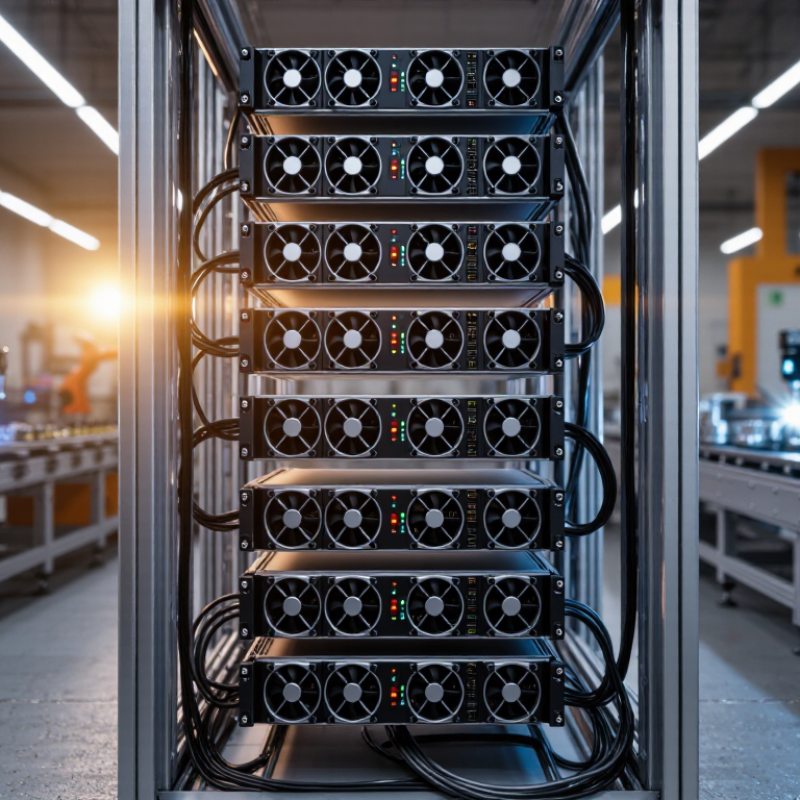
Choosing an industrial AI server manufacturer starts with defining the work, not comparing product labels. Describe each use case in operational terms. A vision line may inspect 12 cameras, detect surface defects, and respond within 80 milliseconds. A predictive maintenance system may process vibration data every second. These details determine GPU capacity, CPU performance, memory, storage, and network design. Record ambient temperature, dust exposure, vibration, cabinet space, and power limits. A factory floor is not a quiet data center.
Tips: Build a requirement sheet for every application. Include input types, camera resolution, model size, response time, daily workload, and expected growth. Ask manufacturers for measured performance under similar conditions. Request thermal data, component life expectations, remote management options, and repair procedures. Claims without test conditions are difficult to trust.
Do not size the server from peak accuracy alone. Measure inference latency during realistic production shifts. A system that performs well in a laboratory may slow down beside hot machinery. I have seen teams overestimate future workloads and pay for unused capacity. The opposite mistake is more painful: insufficient memory can force frequent upgrades. Run a small pilot with representative data, then review failures honestly. Requirements often change after operators touch the system.
Choosing an industrial AI server manufacturer requires more than comparing processor speed or storage capacity. Examine the team’s engineering expertise, especially in thermal design, system integration, and edge computing. Experienced manufacturers can explain how their servers perform inside factories, vehicles, or dusty control rooms. Ask for deployment records, testing procedures, and measurable reliability data. A polished datasheet may still hide weak cooling or limited technical support.
Tips: Request sample test reports. Check service response times. Speak with existing users. Inspect the factory when possible.
Industry experience matters because every environment creates different risks. A server near heavy machinery may face vibration, heat, and electrical interference. The manufacturer should describe protective designs and maintenance requirements in practical terms. Look for traceable quality controls, clear warranty conditions, and documented component availability. No checklist is perfect. A supplier can have strong hardware but lack useful field support, which becomes expensive during an unexpected failure.
Evaluate communication, too. Technical answers should be specific, not impressive but vague. Ask how firmware updates are controlled and how failures are diagnosed remotely. Independent certifications can strengthen credibility, but they should support real evidence rather than replace it. A careful buyer should compare promised performance with verified results, then leave room for doubts. Industry experience is valuable when it produces dependable decisions, not just confident claims.
Choosing an industrial AI server manufacturer requires more than reading peak GPU numbers. In field evaluations, sustained performance matters more than a brief benchmark result. Check GPU memory, CPU lanes, storage bandwidth, and thermal behavior under continuous workloads. A server processing camera feeds should maintain stable inference on the plant floor, not only in a cool laboratory. Ask for measured results using your model, input size, and batch setting. Small details matter.
Scalability should be tested before expansion becomes urgent. Look for spare PCIe capacity, accessible drive bays, redundant power, and clear cooling margins. A two-node pilot may become a twelve-node cluster within a year. Can the manufacturer provide matching systems, remote monitoring, firmware control, and replacement parts? Rack depth and power draw also affect installation costs. Bigger is not always better. Sometimes, it is wasteful.
AI compatibility includes more than accelerator support. Confirm drivers, operating system options, container tools, inference frameworks, and industrial networking interfaces. Request a documented compatibility matrix, then run a proof of concept with your actual data. I have seen technically strong hardware lose time because a sensor driver was missing. That mistake is preventable, but not always cheap. Reliable manufacturers explain limitations, publish service response terms, and answer performance questions without hiding behind specifications. Also assess security updates and lifecycle availability. A fast server with uncertain support can become an expensive obstacle.
Choosing an industrial AI server manufacturer requires more than comparing processor speed. Security should begin at the factory. Ask for secure boot, signed firmware, hardware root of trust, and vulnerability disclosure procedures. The 2024 Cost of a Data Breach study placed the global average breach cost at 4.88 million dollars. One overlooked management port can become an expensive weakness.
Compliance evidence must be practical, not decorative. Request ISO 27001 certification, supply-chain controls, software bills of materials, and documented patch timelines. NIST’s AI Risk Management Framework stresses governance, measurement, and monitoring throughout an AI system’s lifecycle. A supplier that cannot explain firmware updates clearly deserves deeper questioning. Paperwork alone is not protection.
Support directly affects total cost of ownership. Confirm spare-parts availability, on-site response targets, remote diagnostics, and warranty limits. The International Energy Agency projects data-center electricity demand could more than double by 2026. Therefore, compare performance per watt, cooling requirements, rack density, and power prices over five years. The cheapest server may consume more electricity and require earlier replacement. I would also test a real workload before signing. Benchmarks can mislead. My own judgment could still be wrong, especially when future model sizes remain uncertain. A transparent manufacturer should provide assumptions, calculation tools, and failure data rather than promising perfect efficiency.
| Assessment Dimension | Evaluation Metric | Recommended Benchmark | Evidence to Request | Suggested Weight | Risk if Requirement Is Not Met |
|---|---|---|---|---|---|
| Security | Secure boot and hardware root of trust | Verified boot enabled by default; TPM 2.0 or an equivalent trusted platform module; signed firmware and bootloader updates | Architecture documentation, BIOS screenshots, firmware-signing process, independent security test results | 10% | Unauthorized firmware modification, malware persistence, and weaker device identity protection |
| Data encryption and key management | Encryption at rest using AES-256 or equivalent; TLS 1.2 minimum and TLS 1.3 preferred for data in transit; customer-controlled keys where feasible | Encryption configuration, certificate-management procedure, key-management integration guide | 8% | Exposure of production data, credentials, model artifacts, or video and sensor streams | |
| Vulnerability management | Published vulnerability disclosure process; critical security patches targeted within 30 calendar days; signed update packages and rollback capability | Product security policy, sample advisories, patch history, software bill of materials availability | 8% | Long exposure windows and increased likelihood of exploitation across connected industrial assets | |
| Identity and access control | Role-based access control, multi-factor authentication for administrative access, centralized logging, and least-privilege configuration | Access-control matrix, audit-log examples, authentication integration documentation | 6% | Unauthorized changes to models, operating systems, network settings, or production workloads | |
| Industrial network segmentation | Separate management, inference, storage, and operational networks; support for firewall rules, VLANs, and secure remote administration | Reference network architecture, hardening guide, remote-access controls, penetration-test scope | 5% | Lateral movement from an office or internet-facing network into operational technology environments | |
| Compliance | Information-security management | Current ISO/IEC 27001 certification or an independently audited equivalent control framework relevant to the supplied services | Certificate, statement of applicability, audit scope, expiry date, and remediation summary | 7% | Additional audit effort and uncertainty regarding governance, risk management, and information-security controls |
| Industrial automation security practices | Development and product-security processes aligned with IEC 62443 principles; clear responsibility for system integrators and operators | Secure-development lifecycle description, threat model, security testing report, lifecycle support policy | 7% | Poor alignment with plant-level security controls and greater difficulty passing industrial cybersecurity reviews | |
| Privacy and data residency | Documented processing purposes, retention periods, deletion procedures, and data-location options appropriate to the applicable privacy laws | Data-processing terms, privacy impact materials, subprocessors list, retention and deletion controls | 5% | Regulatory penalties, restricted deployments, or inability to process personally identifiable data lawfully | |
| Supply-chain transparency | Traceable component origin, documented firmware and software dependencies, and an SBOM in a machine-readable format when applicable | SBOM sample, supplier-risk policy, component traceability records, counterfeit-part controls | 4% | Difficulty investigating vulnerabilities, meeting customer procurement rules, or proving component provenance | |
| Support & Reliability | Availability and response commitment | 24/7 escalation for critical production incidents; initial response within 1 hour for critical severity; defined service credits or escalation path | Support-level agreement, severity definitions, escalation contacts, historical response metrics | 8% | Longer production downtime and slower recovery from hardware, driver, or model-serving failures |
| Warranty and replacement logistics | At least 3 years of warranty coverage; advance replacement or on-site service options for business-critical installations | Warranty terms, repair turnaround target, spare-parts locations, return-material authorization procedure | 5% | Extended outages and unplanned inventory costs caused by slow component replacement | |
| Lifecycle and compatibility support | Minimum 5-year platform availability target; documented support for operating systems, drivers, AI frameworks, storage, and industrial interfaces | Product lifecycle statement, end-of-sale notice period, compatibility matrix, upgrade policy | 5% | Premature replacement, software incompatibility, and expensive revalidation of production systems | |
| Deployment and technical expertise | Documented commissioning procedure, remote diagnostics, acceptance testing, and engineers experienced with industrial environments | Implementation plan, test protocol, training materials, named technical roles, customer references without confidential data | 4% | Configuration errors, delayed go-live, and higher dependence on internal engineering resources | |
| Total Cost of Ownership | Acquisition and deployment cost | Compare hardware, software, installation, integration, testing, training, and commissioning as a single delivered-cost estimate | Itemized quotation, licensing terms, implementation assumptions, payment schedule, and excluded-cost list | 6% | Budget overruns caused by hidden integration, software, or site-preparation charges |
| Energy and cooling efficiency | Measure watts per sustained inference or training workload; include peak demand, cooling load, rack capacity, and local electricity rates | Workload benchmark using representative models, power measurements, thermal specifications, and operating assumptions | 5% | Higher utility bills, insufficient facility capacity, and reduced hardware lifespan from thermal stress | |
| Maintenance, upgrades, and consumables | Include preventive maintenance, storage replacement, spare parts, software subscriptions, model updates, and technician labor over 3 and 5 years | Five-year cost model, maintenance schedule, upgrade pricing, subscription renewal terms, and spare-parts assumptions | 4% | Low initial price becomes expensive after recurring support, upgrade, and maintenance charges | |
| Downtime and exit-cost exposure | Quantify expected downtime cost, migration effort, data-transfer requirements, retraining, and replacement options before contract approval | Business-impact analysis, portability statement, data-export procedure, termination assistance, and disaster-recovery test results | 4% | Vendor lock-in, costly migration, lost production output, and extended recovery time | |
| Total Evaluation Weight | 100% | Use a 1–5 score for each metric and multiply by the assigned weight. | |||
How to Choose an Industrial AI Server Manufacturer
Select and Validate the Best Industrial AI Server Manufacturer
Selecting an industrial AI server manufacturer starts with the workload, not the sales brochure. Define camera streams, model size, response time, storage needs, and operating temperature. A factory gateway may need low-latency inference, while a design laboratory may require several accelerators. Ask for measured performance under your exact workload. Peak benchmark numbers can mislead.
Request a complete validation unit before signing a large contract. Run your models continuously for several days. Check inference latency, power draw, fan noise, and thermal behavior inside a realistic cabinet. Inspect the logs after sudden restarts. Test network recovery and storage replacement. Small details matter. During one evaluation, a server passed the benchmark but throttled after two hours in a warm enclosure. That result changed the purchase decision.
Review the manufacturer’s engineering evidence carefully. Look for clear component specifications, firmware controls, lifecycle planning, repair procedures, and documented quality testing. Confirm the availability of spare parts and technical support in your region. Ask who handles failures and how quickly they respond. Request references from facilities with similar dust, vibration, and uptime requirements. A polished presentation is not proof. I also prefer written answers, although written promises can still be incomplete. Validate them through tests, inspection records, and a pilot installation. Keep acceptance criteria measurable, including maximum temperature, recovery time, and sustained performance.
Recommended evaluation weighting for selecting and validating an industrial AI server manufacturer
Prioritize compute performance, environmental durability, and reliability when validating an industrial AI server. Also assess long-term support, cybersecurity, manageability, and expansion options before making a final procurement decision.
Look for experience in thermal design, system integration, and edge computing. Ask how servers operate in factories, vehicles, and dusty control rooms. Test it yourself.
Request deployment records, sample test reports, and measurable failure data. Speak with existing users and review service response times. A polished datasheet is not enough.
Heavy machinery can create vibration, heat, and electrical interference. Ask about protective designs, cooling methods, and maintenance requirements. Real conditions matter.
Hardware can be strong while field support remains weak. Confirm remote diagnosis, replacement procedures, spare-parts availability, and on-site response targets. An unexpected failure can become expensive.
Ask for secure boot, signed firmware, and hardware-based trust controls. Review management-port protection and vulnerability disclosure procedures. One overlooked port can create serious risk.
Request recognized security certifications, supply-chain controls, and software component records. Also ask for documented patch timelines and update responsibilities. Paper is not protection.
Compare purchase price, electricity use, cooling needs, rack space, support, and replacement timing. Measure performance per watt over several years. The cheapest server may cost more later.
Benchmarks can hide workload differences, cooling limits, and uncertain future model sizes. Run a representative workload before signing, using realistic data and operating conditions. My judgment could still be wrong.
Choosing the right industrial ai server manufacturer begins with clearly defining your operational requirements and intended AI use cases. Consider the workloads involved, such as real-time analytics, machine vision, predictive maintenance, or edge processing, along with environmental conditions, deployment locations, and future expansion plans. A qualified manufacturer should demonstrate strong technical expertise, reliable production capabilities, relevant industry experience, and a proven understanding of industrial computing challenges.
Next, compare server performance, processing power, GPU and accelerator compatibility, memory capacity, storage options, scalability, and integration with existing systems. Security features, regulatory compliance, technical support, warranty coverage, maintenance services, energy efficiency, and total cost of ownership are equally important. Before making a final decision, request detailed specifications, verify performance through testing, evaluate service responsiveness, and conduct a practical validation under real operating conditions. This structured approach helps organizations select a dependable solution that delivers long-term value, stable performance, and flexibility as AI requirements evolve.
